
Bank Connections: Syncing, Reconnecting, Missing Transactions
Connect a client's bank and card accounts, map each one to an account in the chart, and keep the feed healthy: sync, reconnect, pause, extend history, unlink, and find transactions that seem to be missing.
On this page
Bank connections is where a client's banks live in Books. You connect a bank once, tell Books which account in the chart each bank account belongs to, and from then on its transactions arrive in the Review queue for you to categorize and match. This page is also where you check that every connection is still syncing, and fix the ones that are not.
Nothing a bank sends reaches the books until the bank account is mapped. A new connection's lines wait, invisible, until you map each account to an account in the chart of accounts. Once mapped, its lines appear in Review. They still post only when you post them, or when automation you turned on does (a rule, or automatic match confirmation).
Understand the Bank connections page
The title shows a count under it: for example, 3 institutions · 5 accounts · last sync 9:45 AM. If a bank has stopped syncing, a red banner across the top says so before anything else (see Reconnect a bank).
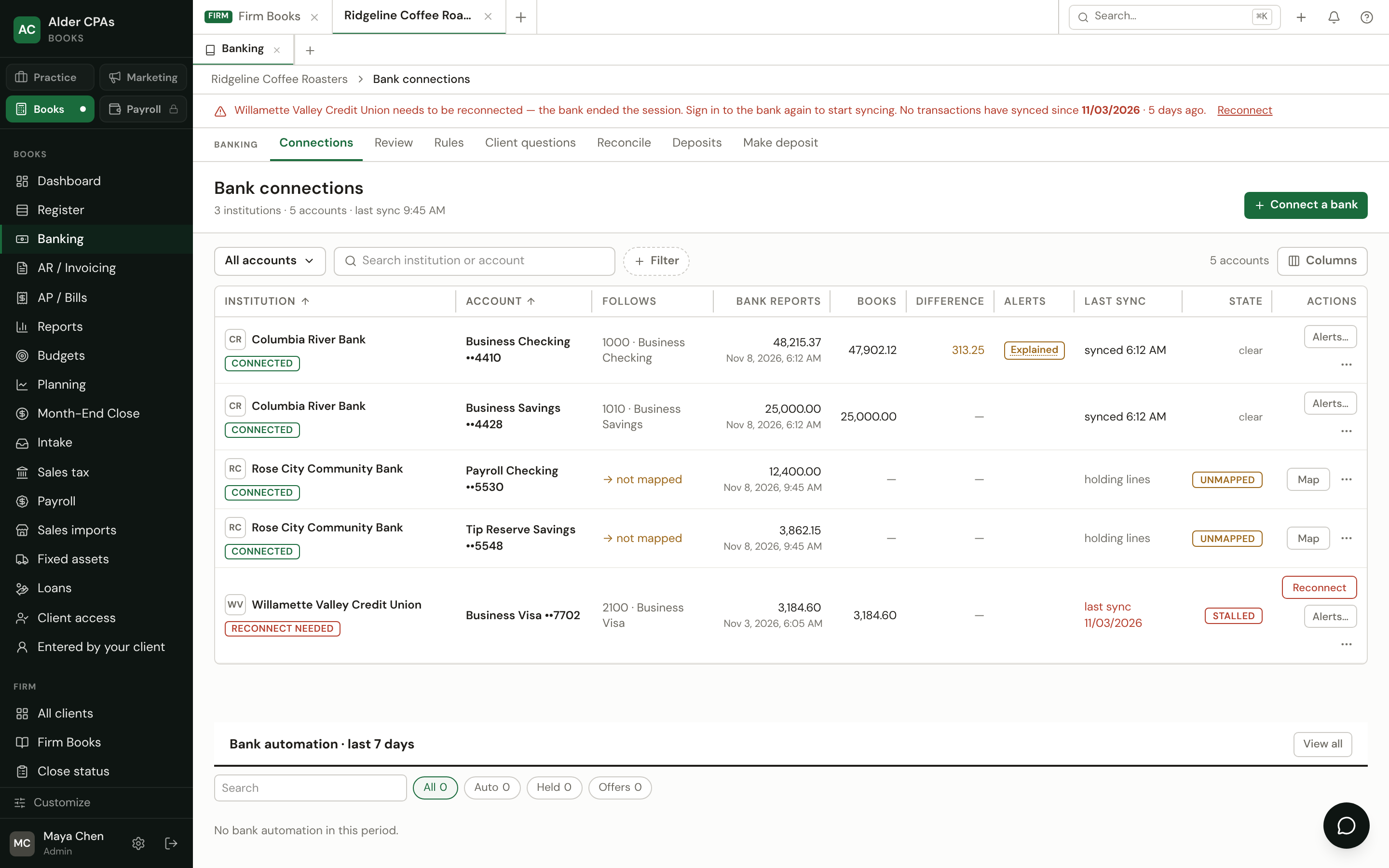 Ridgeline Coffee Roasters' bank connections: one bank needing a reconnect, two new accounts waiting to be mapped, and a checking account whose difference is explained by lines in review and a deposit the bank does not show yet
There is one row per bank account. A connection with several accounts (here, checking and savings at Columbia River Bank) gets one row for each. The columns, in order:
-
Institution — the bank, and the connection's status: Connected, Reconnect needed or Disconnected. A connection you paused also shows Paused, and one you unlinked shows Unlinked. An account you bring in by uploading statements shows Statement upload instead.
-
Account — the bank's name for the account and its last four digits, such as Business Checking ••4410.
-
Follows — the account in your chart it posts to, such as 1000 · Business Checking, or → not mapped in amber.
-
Bank reports — the balance the bank reported, with the date and time it reported it. Not reported yet until the bank sends one. For an account fed by uploaded statements it is the ending balance of the latest statement, or No statement yet (No ending balance when the statement states none).
-
Books — that account's balance in the books on the day the bank reported.
-
Difference — the bank's balance less the books'. A dash means they agree. An amber figure is a gap that the items Books can name explain (bank lines the books don't have yet, and entries in the books the bank doesn't show yet), to within the account's alert threshold; see The balance doesn't match the bank?.
A red figure means the part those items don't explain is larger than that threshold (the Balance differs from the books amount in the row's alerts). A small unexplained gap shows in plain type.
-
Alerts — chips such as Explained, Check matches, Balance differs, Low balance, Over limit or a credit card's share of its limit (for example, 80% of limit). Hover a chip to read what it saw. The bell button on the row (Alerts…, with the number of open alerts beside the bell when there are any) sets them: Balance differs from the books on every account, Low balance on checking and savings, and Credit use on a card or loan.
-
Last sync — synced 6:12 AM for today, a date for earlier days. It reads holding lines for an account that is not mapped yet, not yet synced for one that has never synced, and turns red (last sync 11/03/2026) when the connection has stopped.
-
State — clear, Unmapped, Stalled (the bank stopped syncing) or unlinked; an account fed by uploaded statements reads not checked until its balance can be compared, and Differs when it doesn't agree.
-
Actions — the row's buttons (Map on an unmapped row, Reconnect on a connection whose bank ended the session, Connect again on one that was unlinked or that the bank disconnected, Remove on one the bank disconnected, Upload a statement on a statement-upload account, the Alerts… bell on a mapped account other than an investment, and Adjust to market value… on an investment), and a ⋯ menu with Sync now, Review lines, a mapping item and Account settings.
The mapping item is Map to your chart of accounts on an unmapped row and Change mapping on a mapped one. Change mapping is off once transactions have posted, and hovering it says Transactions have posted to this account, so its mapping is locked.
Use Search institution or account to find a row, and Filter to narrow by Institution, Connection status or State. Click any row to open that account's page.
Your firm's own books (Firm Books) have the same page.
Connect a bank
Live bank connections are part of Premium, for each client. Your firm also has to finish a one-time bank connection setup, and be approved, before any client can connect a bank. Until then, Banking says what is left and offers the next step (for example, Set up bank connections); the firm's owner or an admin takes it.
-
Click Connect a bank.
-
If the Bank connection terms have changed since your firm accepted them, Books shows the new version before the bank's window opens. An owner or admin reads them, checks I agree to the bank connection terms on behalf of my firm, and I am authorized to accept them., and clicks Accept and continue.
Anyone else is told that only an owner or admin can accept them, and who, when Books knows. Connections you already have keep working while the new version waits.
-
Your bank's sign-in window opens. Pick the bank, sign in, and choose the accounts to share.
-
Books confirms what it connected, for example: Rose City Community Bank connected — 2 accounts. Account types Books doesn't follow are left out, and the notice says how many: …, 1 not supported and skipped. The first import starts at once, and a line under the page header says how it went (see The first import).
-
Map accounts opens on its own. Map each account as described next.
Some banks sign you in on their own website and then send you back to Books, on a page titled Connecting your bank. Books finishes the connection there (Rose City Community Bank is connected: 2 accounts.), starts the first import on the same page, and shows how it went under that sentence. Click Back to Banking, then click Map on each new row.
When it was a Connect again that Books took onto an existing row, that page says Rose City Community Bank connected again · the same connection, with its accounts and their mappings · bringing in what it missed now. instead, as the Banking page does, and its accounts keep their mappings: click Map only on a row that reads Unmapped (see When the bank disconnected it).
Closing the bank's window before you finish is not an error: nothing is connected, and you can start again.
Map the new accounts
Mapping decides which account in your chart each bank account posts to. It is a one-time decision you make on purpose, so Books never guesses.
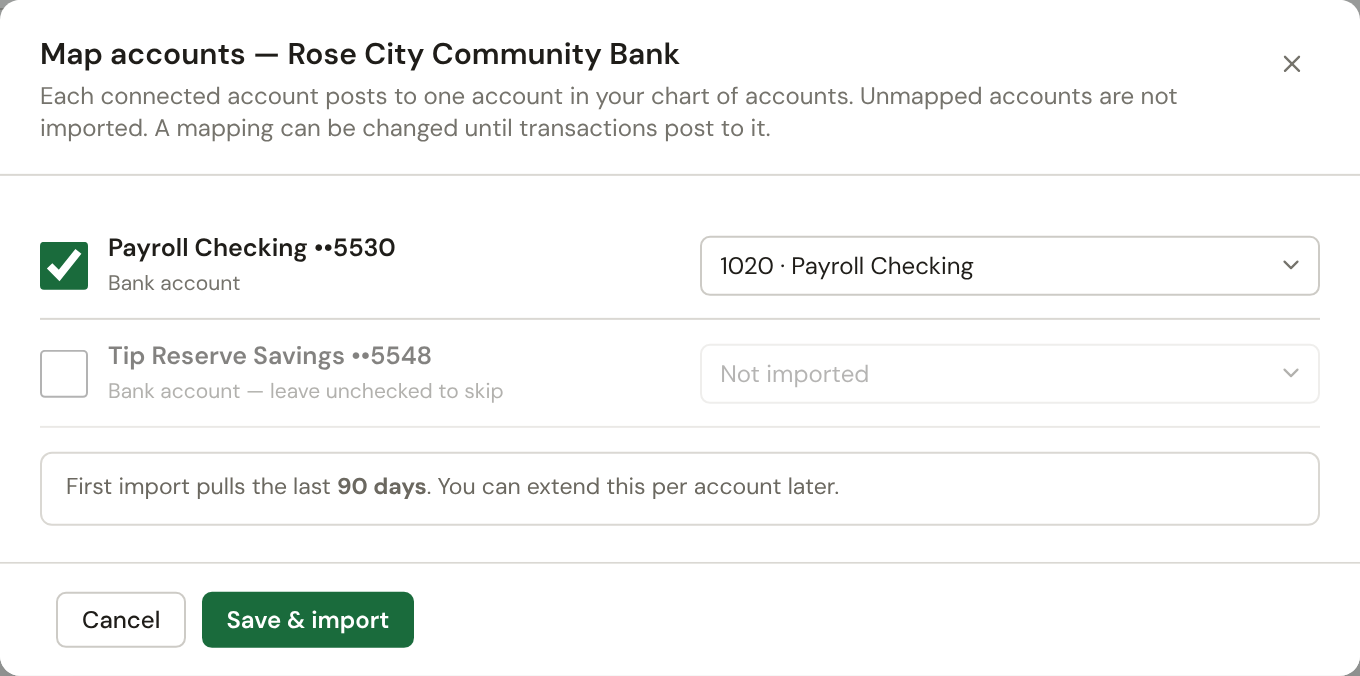 Map accounts for a new connection: payroll checking mapped to 1020 · Payroll Checking, the savings account left unchecked
- Check the box beside each account you want to bring in. An account you leave unchecked is skipped (its row reads — leave unchecked to skip) and nothing from it reaches Review or the books.
- For each checked account, pick the account in your chart. Type a number or part of the name to narrow the list; ↓ and ↑ move through it, Enter picks, and Esc closes it. Only accounts of the right kind are offered: bank accounts for checking and savings, credit card accounts for a card. Archived accounts, and accounts another part of Books maintains, are not offered.
- Click Save & import. It stays off until every checked account has an account picked.
The first import brings in the last 90 days. You can extend the history for each account later.
The first import
A bank sends a new connection's most recent activity first and the rest of its history afterward, so the line under the page header says where the history stands:
- Connected at 9:47 AM · activity back to Oct 2, 2026 is in (41 new feed lines); the rest of the 90 days is still arriving and will sync on its own. While an account is not mapped yet, it ends will sync on its own once its accounts are mapped.
- Connected at 9:47 AM · … the rest of the 90 days arrived during this sync and syncs in a moment.
- Synced at 9:52 AM · 90 days in · 63 new feed lines when the whole history has come in.
The account isn't in the chart yet? Choose + New account… at the bottom of the list. Books opens New account with the name filled in from the bank (for example, Rose City Community Bank Tip Reserve Savings ••5548), the type (Bank (Asset) or Credit Card (Liability)) and the next free number.
Change any of them, then click Create and map: the account is added to the chart and picked for you, and the row says New account added to the chart.
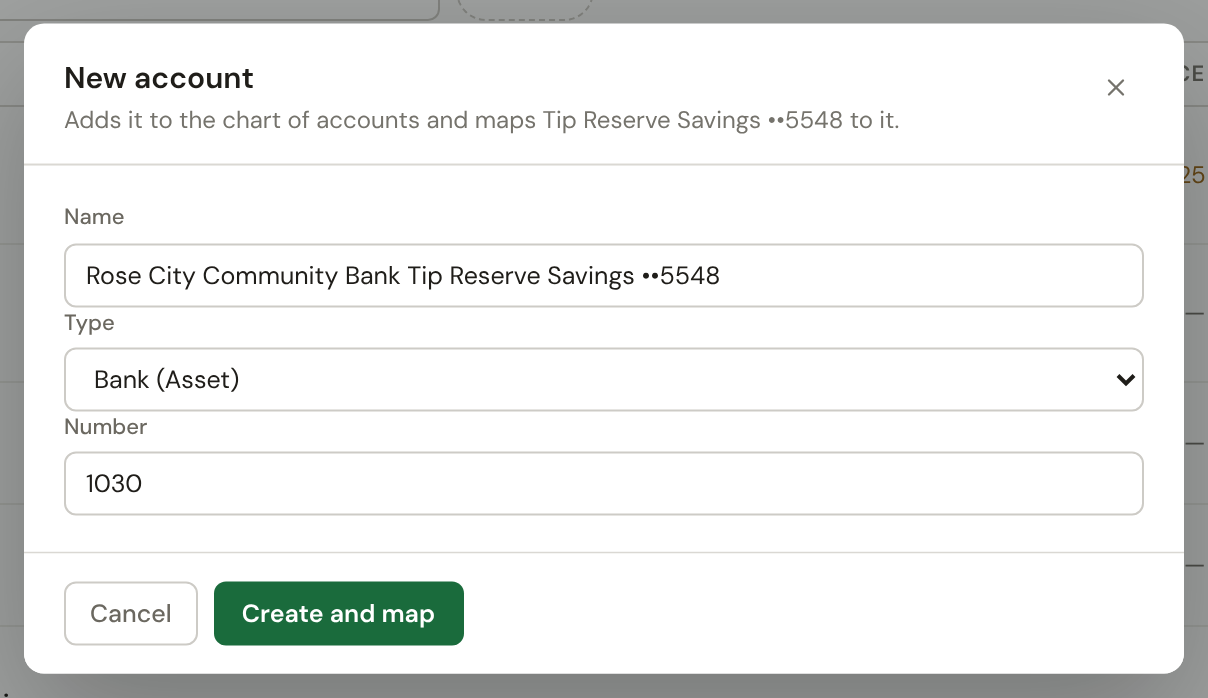 New account, filled in from the bank account
A loan or investment account on the same connection doesn't post its transactions; it follows a balance instead.
Map an account later
If you close Map accounts without saving, or leave an account unchecked, its row stays Unmapped and its Last sync reads holding lines. While another account at the same bank is mapped, Books keeps receiving this one's lines and holds them. Click Map on the row to open Map accounts again. Lines already held appear in Review as soon as you save; anything newer comes with the next check.
Sync now
Connected accounts sync on their own while the client is on Premium; if the client's Premium ends, scheduled syncing stops. To bring in the latest right away, open the row's ⋯ menu and choose Sync now, or open the account and click Sync now at the top right.
Books says what the sync did. On Banking, a line under the page header names the bank and the result; on the account page, its Last sync row does. For example:
- Syncing now · started 9:45 AM, while it runs
- Synced at 9:47 AM · 6 new feed lines · 1 updated · 1 match proposed
- Sync failed at 9:45 AM · followed by the bank's reason
- Not started · followed by why Books did not try (see Why can't I sync?)
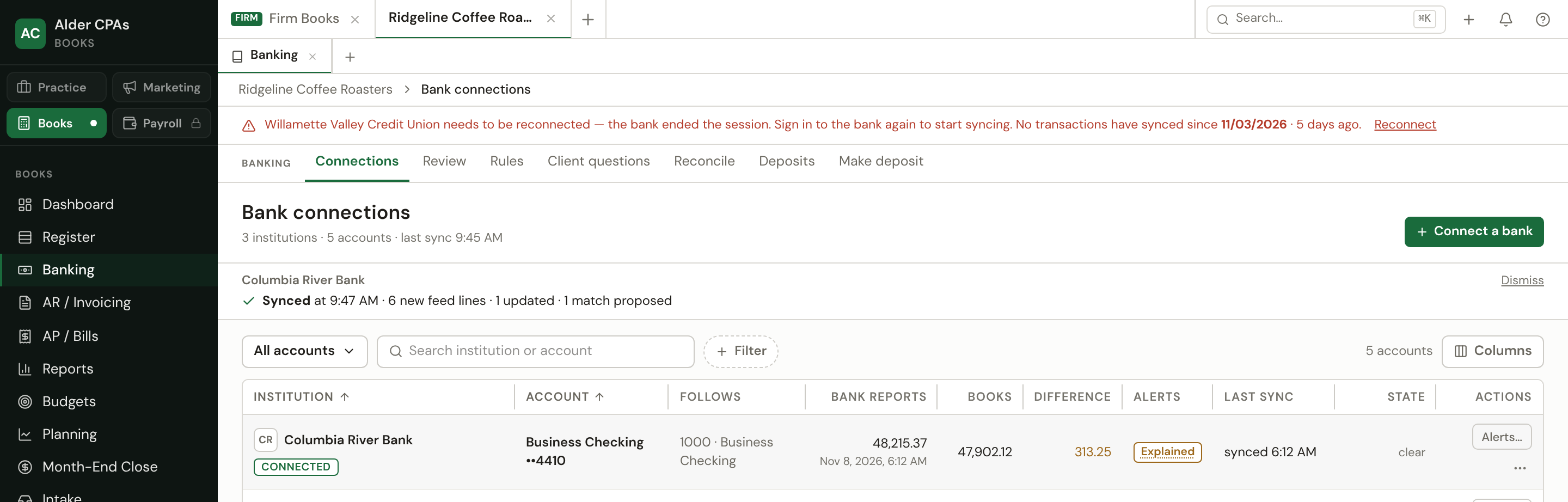 Banking after Sync now on Columbia River Bank: the line under the header says what the sync brought in
Anything unusual the sync saw is listed under the result, for example 3 older than this account's history window were not imported. Extend the history on the account to bring them in. The same line appears after the first import of a new connection and after a reconnect. Click Dismiss on Banking to put it away.
A sync brings lines into Review. Posting them is up to you, or to automation you turned on yourself (see How rules and matches earn automatic posting).
Reconnect a bank
Now and then a bank ends a connection's sign-in. When that happens, the connection shows Reconnect needed and a banner appears at the top of Banking:
Willamette Valley Credit Union needs to be reconnected — the bank ended the session. Sign in to the bank again to start syncing. No transactions have synced since 11/03/2026 · 5 days ago.
The same banner appears on the Review page, so you can't miss it while you work through lines.
- Click Reconnect in the banner, or on the connection's row.
- Sign in to the bank in its window, the same way you connected it.
- Books syncs the connection again and asks the bank for its full history, so the lines it missed while it was stopped come in. Lines already in Books are not brought in twice, and lines you already posted are left as they are.
Books confirms it, for example: Willamette Valley Credit Union reconnected · bringing in what it missed now. Your mappings, rules and posted history stay as they were, so Map accounts doesn't open. Reconnecting doesn't need anyone to accept the bank connection terms again.
When the bank disconnected it
Disconnected means the bank ended the connection itself. Signing in again can't repair that, so there's no Reconnect. The banner says:
Rose City Community Bank was disconnected by the bank, so signing in again can’t repair it. Connect it again: the new connection takes its place, with the same accounts and their history.
-
Click Connect again in the banner or on the row, and connect the bank as you would a new one (your firm's approval and the current bank connection terms apply, as for any new connection).
-
Books takes the new connection onto the old one's row and says so: Rose City Community Bank connected again · the same connection, with its accounts and their mappings · bringing in what it missed now.
Each account it recognizes by type and last four digits keeps its mapping and history, and the banner goes. Map accounts doesn't open. If the bank now shares an account Books didn't have before, its row reads Unmapped: click Map on it.
If the client has more than one disconnected connection at that bank, Books can't tell which one the new connection replaces, so it adds the new one beside them. Click Remove on each old row.
The prompt says what it does, for example Removes the connection to Rose City Community Bank and its 1 account. No transactions are waiting for review, so none are removed; 128 transactions already in your books stay. Nothing syncs from it again. Click Remove connection.
Unlinked is different: someone at your firm unlinked it. It raises no banner, and its row offers Connect again (see Unlink a connection).
The account page
Click a row (or ⋯ → Account settings) to open the bank account's own page. The breadcrumb at the top ends with the account's name; click it to jump to another bank account.
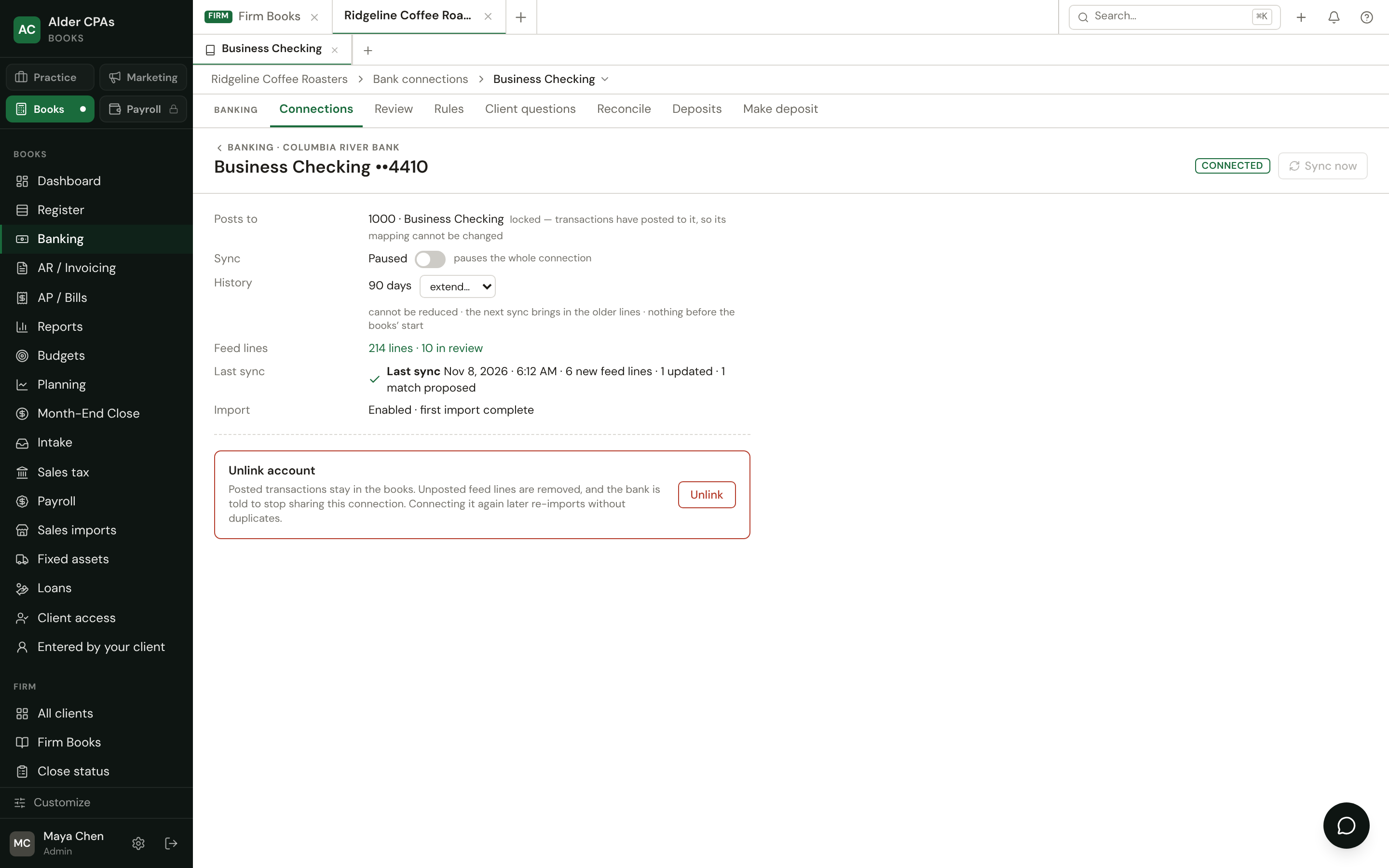 The account page for Business Checking ••4410, with Columbia River Bank paused for this example
- Posts to — the account in your chart, or not mapped — this account is not imported. Once anything has posted from this bank account (a line you posted, a match or a confirmed transfer), Books marks the mapping locked, so the account's posted history stays where it was posted.
- Sync — On · checks for new transactions about every 15 minutes, or Paused, with a switch that pauses or resumes syncing (see below). On a connection that has stopped it says why instead, such as Stopped · the bank ended the session, so nothing syncs until it is reconnected or Off · this connection was unlinked, and the switch can't be used, since there is nothing to pause; the reason is written beside it.
- History — how far back Books imports for this account, and extend… to go further.
- Feed lines — every line the bank has sent for this account and how many are waiting, such as 214 lines · 10 in review. Click it to open Review filtered to this account. For an unmapped account it adds held until this account is mapped — they do not appear in review yet.
- Last sync — the last recorded sync, when it finished and what it brought in, or Last sync failed with the reason and the last successful sync.
- Import — Enabled or Not imported, and first import complete once the first import has finished.
Pause syncing
Turn off the switch on the Sync row to pause the connection. Pausing stops syncing for the whole connection, every account at that bank, not just this one; the row says pauses the whole connection. A paused connection shows Paused on Banking. Turn the switch back on to resume.
Bring in older history
Each account starts with 90 days of history. To go further back:
- Open the account's page.
- On the History row, open extend… and choose a longer window: 180 days, 1 year or 2 years, as far as the bank's link allows.
- The next sync brings in the older lines. Click Sync now if you don't want to wait.
History can be extended but never shortened, so only longer choices are offered. Nothing dated before the books' start is ever imported, whatever you choose, because the opening balances already include it.
How far back you can go is set by what the bank shared when the connection was first made; when that is the limit, the row says so, for example this bank was linked sharing 90 days, and that is as far back as this link goes. Reconnecting doesn't change it.
Settings → Bank feeds
Settings → Bank feeds (under Integrations) shows the same connections as a list of switches.
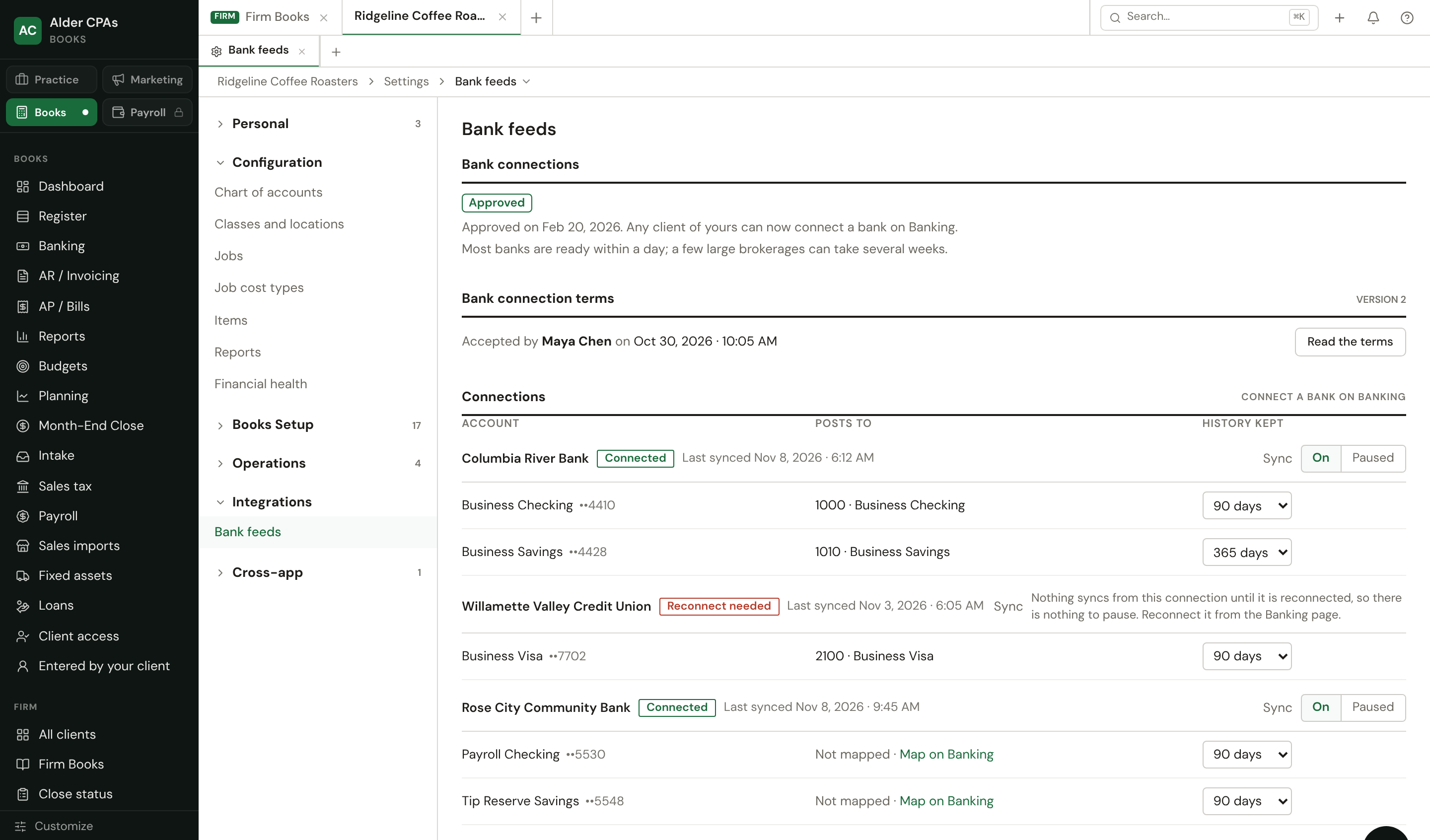 Settings → Bank feeds for Ridgeline Coffee Roasters
-
Bank connections — your firm's one-time setup, here Approved.
-
Bank connection terms — the version your firm accepted, who accepted it and when, and, for an owner or admin, Read the terms.
-
Connections — each bank with its status and when it last synced, a Sync choice of On or Paused, and under it each bank and card account with what it Posts to and the History kept (90, 180, 365 or 730 days, longer only). An unmapped account links to Map on Banking. Statements you upload are listed too, as Statement uploads · nothing syncs from the bank, with no Sync choice.
A connection that has stopped or was unlinked has nothing to pause, so it has no On or Paused either. Sync says why instead:
- When the bank ended the session: Nothing syncs from this connection until it is reconnected, so there is nothing to pause. Reconnect it from the Banking page.
- When the bank disconnected it: Nothing syncs from this connection until it is connected again, so there is nothing to pause. Use Connect again on the Banking page.
- When someone unlinked it: This connection was unlinked. Connect the bank again from the Banking page to start syncing.
Without the Connect and sync bank feeds permission, Sync and History kept are off, and the page says why.
Each change saves as soon as you make it, and Saved confirms it. To connect a new bank, use Connect a bank on Banking.
Why are transactions missing?
Work down this list. Most missing lines are one of the first three.
| What you see | Why | What to do |
|---|---|---|
| Red banner, Reconnect needed (its accounts Stalled) | The bank ended the connection's sign-in, so nothing has synced since the date in the banner. | Reconnect. The missed lines come in afterward. |
| Red banner, Disconnected | The bank ended the connection itself. | Connect it again. |
| Unmapped, holding lines | The account is not mapped, so its lines are held out of Review. | Click Map and save. They appear right away. |
| Paused | Someone paused the connection. | Turn the Sync switch back on, on the account page or in Settings → Bank feeds. |
| The line is older than the account's history | Books imports only the account's history window. When you click Sync now on the account's page, its Last sync row tells you: 3 older than this account's history window were not imported. Extend the history on the account to bring them in. | Extend the history. |
| The line is dated before the books' start | Opening balances already include it, so it's never imported. After you click Sync now, the result says so: … dated before the books' start were not imported — the opening balances already include them. | Nothing to do. |
| The line is still pending at the bank | It is in Review marked Pending · posts when it clears. | Wait for the bank to settle it. |
| You excluded it | It is in Review under the Excluded pill. | Restore to queue there. |
| It's already posted or matched | It left Review when you posted or matched it. | Find it in the register. |
| A foreign-currency transaction | Only USD is imported; after Sync now, the result says how many were skipped. | Record those by hand. |
| Unlinked | Nothing syncs from an unlinked connection. | Connect again. |
The balance doesn't match the bank? Look at the Difference column. Books works out what explains the gap the way a bank reconciliation does, counting each item once, in two groups:
- Bank lines the books don't have yet — lines waiting in Review or pending at the bank. A line Books has proposed as the match for an entry already posted isn't counted: that entry is already in the Books figure.
- Entries in the books the bank doesn't show yet — outstanding checks and deposits in transit: posted, not cleared, dated on or after the account's first bank line, and tied to no bank line.
Both sides are compared on the same day: the client's own calendar day of the bank's figure, the date Bank reports shows.
When those cover the gap, the difference is amber and the Explained chip names each group that has something in it, with its count and total.
For example, it reads: 6 bank lines the books do not have yet, totaling 613.25, including 1 flagged as a possible duplicate and 1 entry in the books the bank does not show yet, totaling 300.00, explain the difference. Each clears when it is posted or matched, or when the bank shows it. Check the line flagged as a possible duplicate. Here the entry is a 300.00 deposit recorded in the books that hasn't reached the bank yet.
A line flagged as a possible duplicate still counts among the bank lines until you decide on it, which is why the chip asks you to check it: if it is a duplicate, exclude it in Review. Post or match the lines, and once the bank shows the deposit, the difference goes to a dash.
If the chip also names entries matched by amount to a bank line marked as a duplicate, it ends with Check it. (or Check them.). Those entries are counted in neither group, because only their amount and date tie them to a bank line you set aside as a duplicate.
Find them in the account's register and make sure each one really is on the bank. When they are the only thing to explain, the chip reads Check matches, with the same sentence.
A red difference means the part those items don't explain is larger than the account's alert threshold: a line missing for one of the reasons above, or an entry in the books the bank never saw. Its Balance differs chip says what the bank and the books report and what is explained, with the same groups.
Why can't I sync this account?
Sync now is off, and hovering it tells you why:
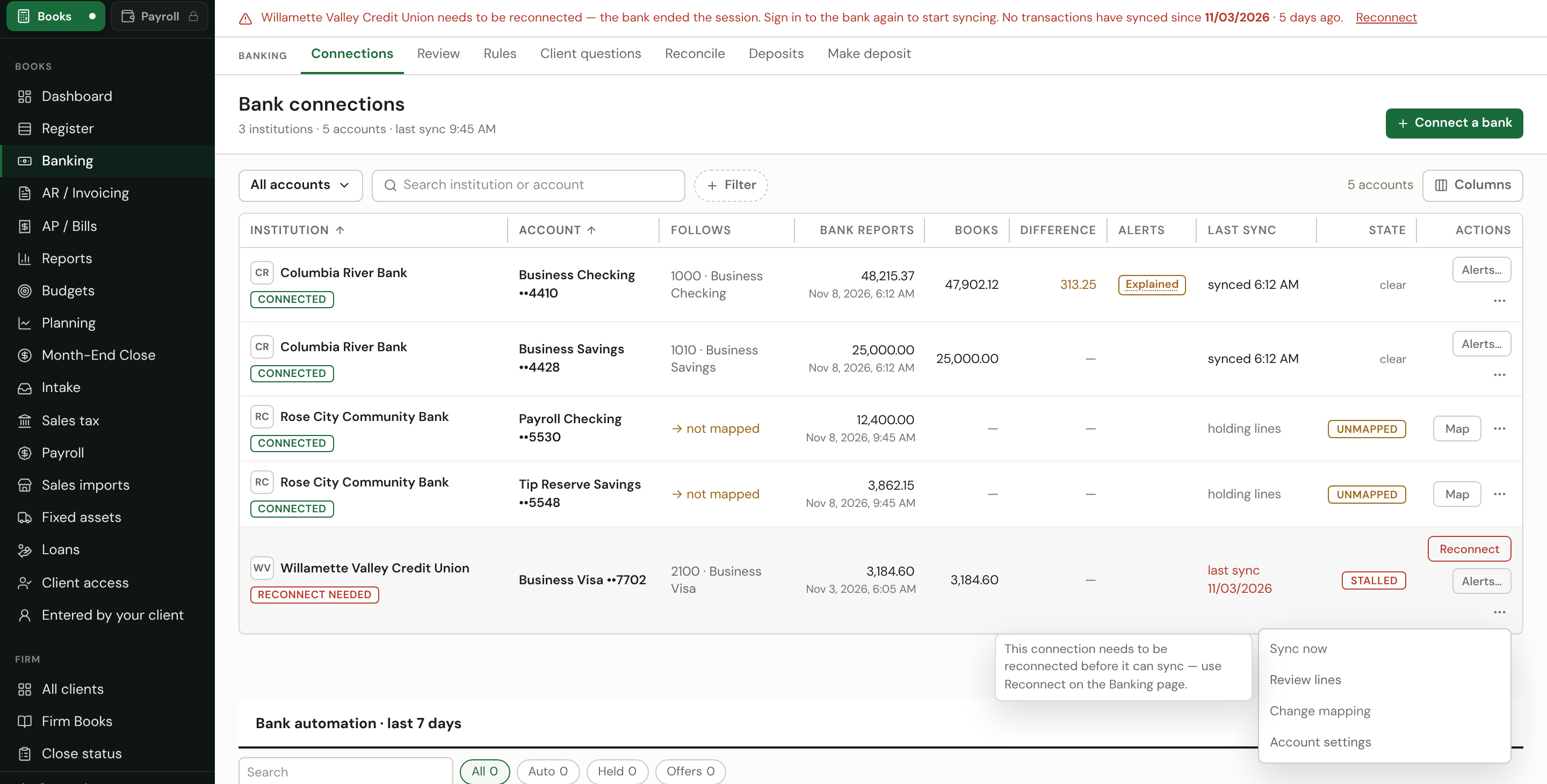 The ⋯ menu on a connection that needs reconnecting, with the reason Sync now is off
- This connection needs to be reconnected before it can sync — use Reconnect on the Banking page.
- The bank disconnected this connection. Use Connect again on the Banking page before syncing. (See When the bank disconnected it.)
- Syncing is paused for this connection. Turn sync back on to import transactions.
- A sync is already running for this connection.
- This connection was unlinked. Connect the bank again from the Banking page to start syncing.
- You need the "Connect and sync bank feeds" permission for this. Ask an admin to grant it. Connecting, reconnecting, syncing, mapping and unlinking all need that permission; a member without it sees the same sentence across the top of Banking.
Why can't I…
-
…connect a bank? Until your firm's bank connection setup is finished, Banking shows what is left instead of letting you connect. Without the Connect and sync bank feeds permission, Connect a bank is off.
If the terms dialog says The bank connection terms have changed, and your firm has not accepted the new version yet. Only an owner or admin can accept them: ask Maya Chen., ask that person to connect the bank, or to accept the terms in Settings → Bank feeds.
-
…pick an account in Map accounts? The list offers only active bank accounts for checking and savings, and credit card accounts for cards. If the client has none, the row says This client has no bank account in its chart of accounts yet. Add one in the chart of accounts, then map this account. Or use + New account….
-
…save a mapping? If the account you picked already receives another bank account's feed, Books refuses with Payroll Checking is already receiving another bank feed. Each account in your chart takes one feed.
When the other feed was unlinked after it posted, the message says so and asks you to choose another account. When the bank disconnected the other feed after it posted, the message says so and ends Use Connect again on that connection to bring its feed back, or choose another ledger account for this one.
-
…see the lines in Review? Their account isn't mapped yet, so Review lines is off in its ⋯ menu. Map it first.
-
…extend history further? The choices stop at 2 years (730 days), and only longer windows than the current one are offered, up to what the bank shared when the connection was first made. Reconnecting doesn't extend that.
-
…pause syncing or extend history? Both need the Connect and sync bank feeds permission. Without it the Sync switch and extend… are off, and the page says why.
Unlink a connection
Unlink when the client closes an account or stops using a bank.
- Open any account at that bank and click Unlink at the bottom of the page.
- Read the prompt. Unlinking takes the whole connection, every account at that bank, not just the one you opened.
- Click Unlink connection.
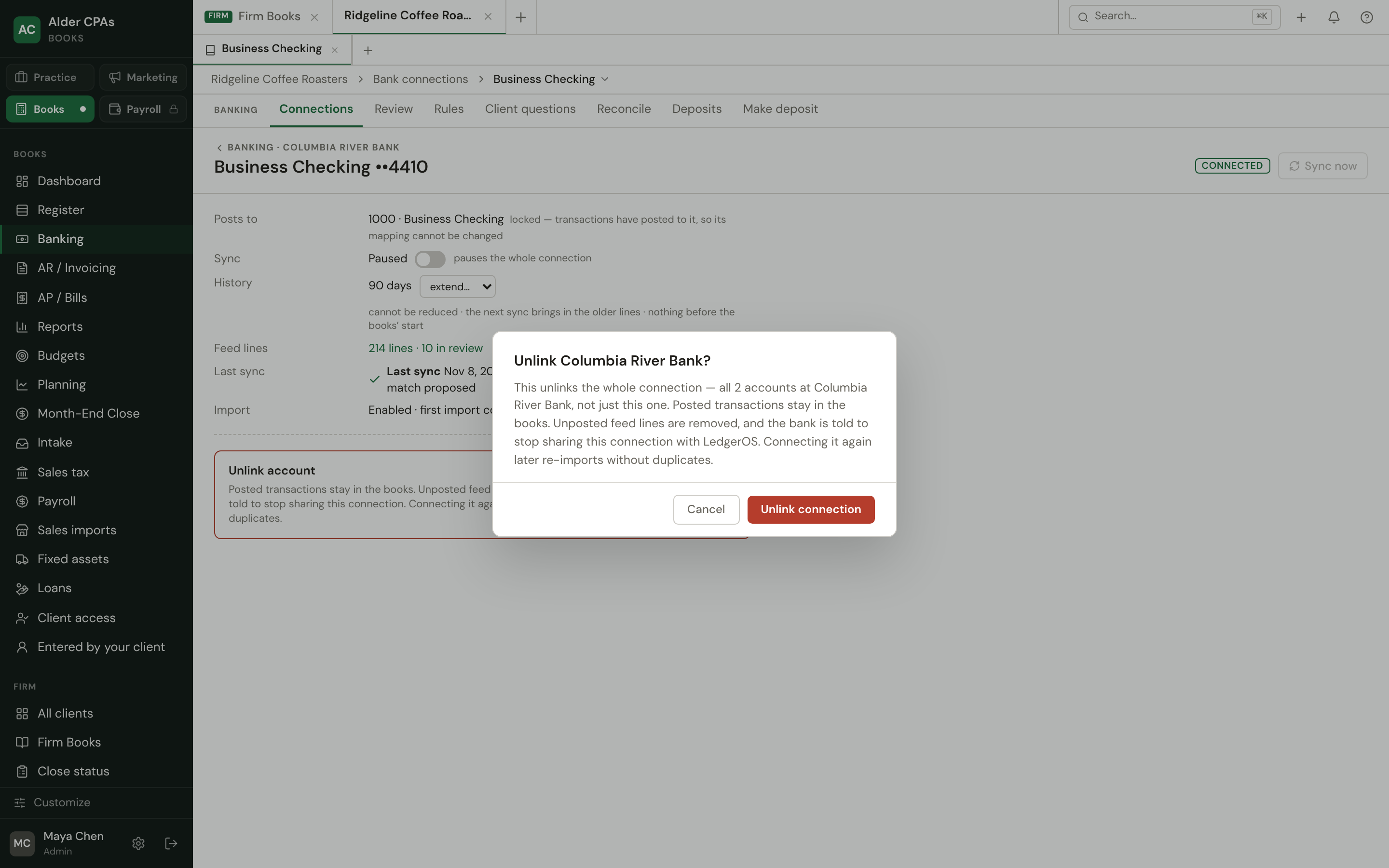 Unlink Columbia River Bank?
What happens:
- Posted transactions stay in the books, and so do lines you matched or posted as transfers.
- Lines still waiting in Review, and lines you excluded, are removed.
- The bank is told to stop sharing the connection with LedgerOS.
- The connection stays on Banking, marked Unlinked, with its history. It raises no reconnect banner.
- An account that never posted anything gives its mapping back, so that account in your chart can take another bank's feed. An account that has posted keeps its mapping with its history.
To start syncing again, click Connect again on the unlinked row and connect the bank as you would a new one. When it is the only unlinked connection at that bank, and none there was disconnected by the bank, Books brings the new connection back onto its row, matching accounts by type and last four digits, and connecting it again later re-imports without duplicates.
Books says … connected again · the same connection, with its accounts and their mappings · bringing in what it missed now., and Map accounts doesn't open. An account that never posted gave its mapping back when it was unlinked, so its row reads Unmapped: click Map on it.
Every client's connections at once
The firm-wide list Bank connections needing attention, opened from the firm dashboard, shows every client's bank connection that needs reconnecting: Reconnect needed when the bank ended its sign-in, and Disconnected when the bank stopped sharing it. A connection someone at your firm unlinked isn't listed.
The columns are Client, Bank, Status, Since and Last sync, with a Fix link on each row, which opens that client's Banking page with the connection highlighted. See Firm-Wide Lists: Open Questions, Bank Connections, Anomalies and Report Sends.
If your firm also uses Practice
When a client's bank needs someone to sign in again, or the bank disconnects it, Books turns it into work on your board instead of waiting for someone to notice the banner.
Practice gets a task on that client, Reconnect Willamette Valley Credit Union bank connection, in the first stage of your Bookkeeping pipeline, marked as created from Books. There is only ever one open task per connection, so a connection that stays broken for a week doesn't fill your board.
The client's page in Practice also carries a Books card whose To review line counts the transactions waiting in Review and notes how many bank connections haven't synced in the last 3 days (your firm can change the number), so the whole team sees a stalled feed without opening Books.
Shortcuts and tips
| Where | Key | What it does |
|---|---|---|
| Account picker (Map accounts) | Type | Narrows the list by number or name |
| Account picker | ↓ / ↑ | Moves through the list |
| Account picker | Enter | Picks the highlighted account |
| Account picker | Esc | Closes the list |
| A row's ⋯ menu | ↓ / ↑, Home / End | Moves through the menu items |
- Check the Difference column after each sync. A dash means the books and the bank agree. An amber figure with Explained clears as you post or match what's waiting in Review and the bank catches up with what's in the books; a red one needs looking into.
- Reconnect from wherever you are. The banner and its Reconnect button are on the Review page too. (Connecting a bank again happens on Banking; the Review banner says so.)
- Use + New account… while mapping rather than leaving to build the chart first; the name comes filled in from the bank.
- Leave accounts you don't keep books for unchecked in Map accounts, such as a personal account at the same bank. Nothing from them reaches Review or the books.
- Extend history before you need it. If you're cleaning up the prior year, extend to 1 year or 2 years and sync; nothing before the books' start ever comes in, so the opening balances stay right.